

An open standard, built by broadcasters.
DRM is the only global digital radio standard covering every currently used frequency band — designed with transmitter and receiver manufacturers and regulators from day one.
What Digital Radio Mondiale actually is
The Digital Radio Mondiale (DRM) broadcasting system has been designed by broadcasters, for broadcasters, with the active assistance and participation of both transmitter and receiver manufacturers and other interested parties, such as regulatory bodies.
DRM is an open standard — its system description is openly published, giving all manufacturers and interested parties free access to the complete technical specifications. They can design and manufacture equipment on an equitable basis without paying a licence fee to the DRM Consortium. This has proved an important mechanism for the timely introduction of new systems to market, and for accelerating the rate at which equipment prices fall.
There is no per-use fee, annual payment, or similar cost for DRM technology — not for broadcasters or network operators, nor for broadcast or receiver equipment manufacturers. The DRM Consortium is not involved in managing or receiving any IPR royalty for DRM products; royalties are paid directly to the individual IPR holders, unless already resolved by a component supplier (e.g. for a DRM receiver module). Further information: ipr.drm.org.
Every band, one standard
DRM is the only global digital radio standard that embraces all the currently used radio frequency bands. It was designed specifically as a high-quality digital replacement for former analogue radio broadcasting in the AM and FM/VHF bands, and can be operated with the same channelling and spectrum allocations already employed.
Four different robustness modes tailor the DRM signal for AM broadcast bands and their diverse propagation characteristics — enabling regional up to international service coverage.
A dedicated robustness mode, centred on the FM broadcast band and optimised for VHF transmissions, is used for local to regional service coverage.
Regulatory backing, real benefits
DRM has received the necessary recommendations from the ITU, providing international regulatory support for transmissions. The main DRM standard is published by ETSI, which also publishes and holds the repository of the entire range of current DRM technical standards.
DRM allows a broadcaster to provide listeners with significant improvements in service reliability, audio quality and, most importantly, usability — with features and facilities impossible to replicate in analogue broadcasting. It is essential that prospective broadcasters understand the potential and flexibility of the system to optimise and configure their DRM networks for their own market conditions.
Consistent, robust reception across diverse propagation conditions.
A clean digital signal replacing analogue hiss, fade and interference.
Multi-channel, EWF and Journaline — impossible to replicate in analogue.
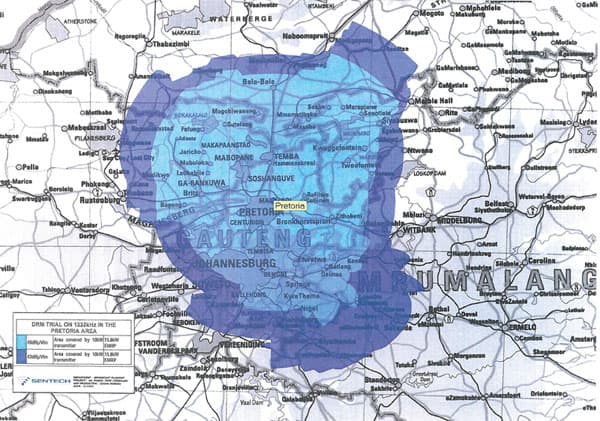
Coverage, measured in the field
Claims about reach mean little until they are measured. This map comes from DRM SA's own field trials, plotting where the digital signal was actually received.
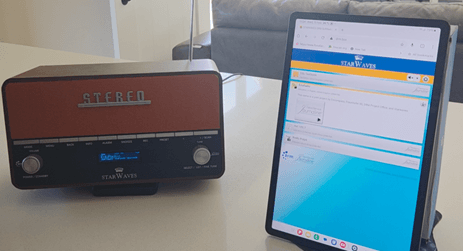
Data alongside the audio, not instead of it
Journaline lets a single DRM signal carry text, images and structured content alongside the broadcast — DRM SA has used it to deliver distance-learning material directly through a standard receiver, no data connection required.